
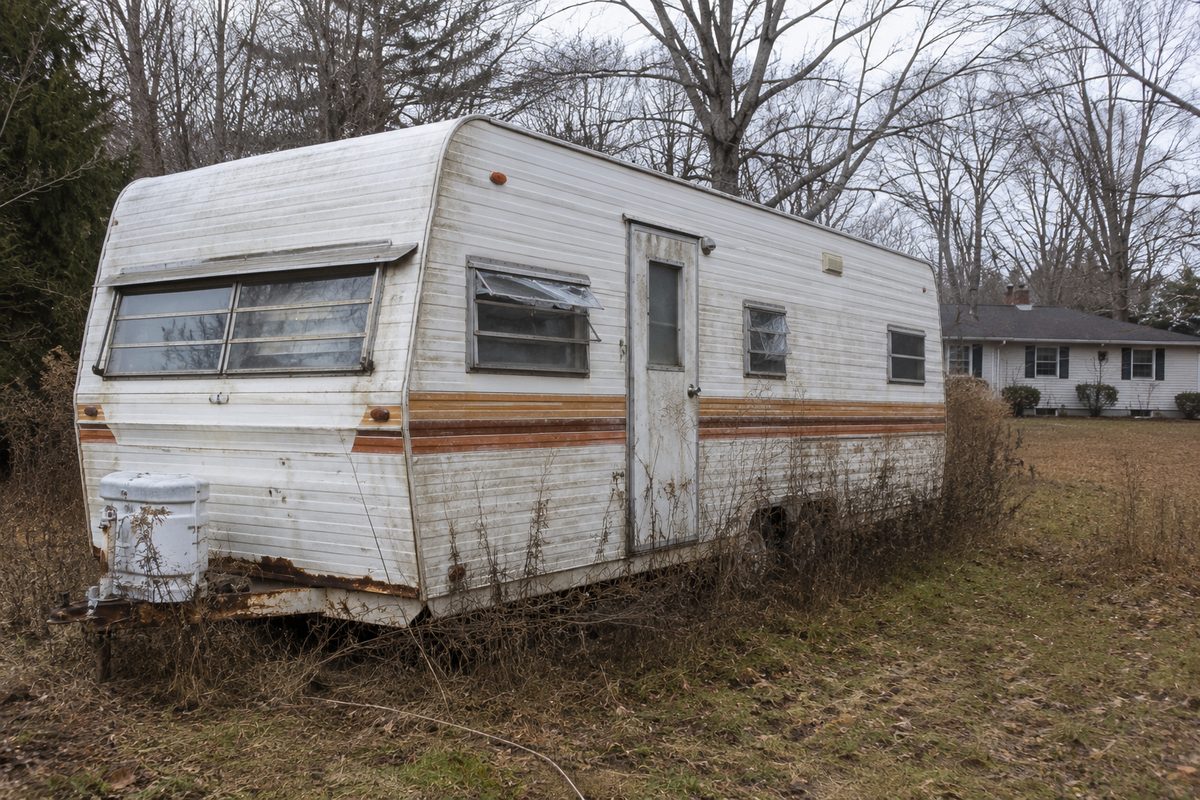
A lot of southern NH yards have an old camper or travel trailer that hasn't moved in years. The tires have flattened, the awning has torn, the roof has a leak that's been growing. At some point the right answer is "get it out of here," but the disposal options for non-running campers are more limited than for regular vehicles. Here's the working guide.
Why campers are a separate question
Campers and RVs aren't easy to dispose of for a few reasons:
- They're heavier than they look (a small travel trailer is 1,500 to 3,000 pounds; a larger Class C motorhome is 6,000+ pounds)
- They need to be towed or driven out, and most that have been sitting for years can't
- Title and registration documentation usually has to be in order
- They're a mix of materials (steel frame, aluminum siding, fiberglass, plastic, electronics, propane systems, water systems)
- The propane tanks need separate handling
For all these reasons, "junk the camper" isn't a single phone call. It's a process.
The realistic disposal options
A few good options for an old camper:
Option 1: Sell or donate to a salvage buyer. If the camper has any working parts (the frame, the axles, the appliances), a small number of salvage buyers will pay something to haul it. The amount is usually low for older non-running units.
Option 2: Scrap metal yard. Some scrap yards take entire campers for the metal value. The camper either gets towed in or hauled by their truck. The scrap yard pays based on weight after subtracting non-metal materials.
Option 3: Demo on site and haul the pieces. This is what we can do. For an old camper that's past restoration and can't easily be towed, we'll bring tools, take it apart on site, and haul the pieces. The frame, panels, plumbing, and interior all come apart and leave with us.
Option 4: Local pickup by an interested party. Occasionally a Marketplace listing for "free or cheap, you haul" finds a taker. More common for newer units in better condition.
Older non-running campers usually end up going through Option 2 or Option 3.
Title and registration
NH requires you to have the title and registration in order before disposing of a registered vehicle, including campers and travel trailers. For older units that have been sitting for years:
- The title. Should be in your name. If it's lost, you'll need to apply for a duplicate at the DMV.
- Registration. Doesn't need to be current to dispose of the unit, but the title chain has to be clean.
If you've inherited a camper or are dealing with an estate situation, the title issue might be more complex. You'll want to have it sorted before the disposal happens.
The propane tank
Every camper has at least one propane tank, usually two. These have to come off before any disposal:
- Remove the tanks from the camper
- Take them to your town's hazmat day (free) or to a propane exchange location
- We can't take propane tanks with the camper
The tanks are easy to remove (usually two threaded fittings) but worth doing before we arrive.
What about water and waste systems
Campers have a fresh water tank, a gray water tank, and a black water (sewage) tank. For a long-unused unit:
- Drain the fresh water tank if it has water
- Confirm the gray and black tanks are empty (not always the case if the camper was used before storage)
- If the black tank has waste in it, it needs to be emptied at an RV dump station before disposal
This is one of the messier parts of older camper disposal. Worth checking before scheduling.
How we approach it
For campers that fit our scope, we bring the tools and break the camper down on site. The structure comes apart into manageable pieces and we haul them out. We'll need:
- Access to the camper (path for the truck and trailer)
- Title and registration sorted
- Propane tanks removed
- Anyone needing to be present for sign-off
An on-site camper demo takes longer than a typical shed or deck demo because of the materials mix.
What we don't do
We're not set up to tow entire campers long distances or coordinate complex DMV transfers. If your camper is in good enough shape to be towed and registered for the road, a regular hauler or RV dealer is a better fit.
Common camper disposal scenarios
Common situations:
- 20-year-old travel trailer that hasn't moved in a decade, parked behind the garage
- Older Class C motorhome on flat tires in the driveway
- Pop-up camper retired after the kids grew up
- Inherited camper from a relative's estate that's past restoration
The work is similar across all of these. Access and prep are the variables.
The booking call
For camper or RV disposal, the questions are:
- Type and approximate age (travel trailer, fifth wheel, motorhome, pop-up)
- Length
- Condition (structurally sound, falling apart, somewhere in between)
- Title situation
- Location and access
Photos are extremely helpful for this kind of job. Text photos and the address to 603-634-9947.
Call 603-634-9947 to discuss. Camper jobs take more coordination than a standard pickup, so plan on a longer first call.